Model-theoretic interpretation
Introduction
Model-theoretic semantics in linguistics aims to define correspondences between the expressions of a language and objects that are external to that language. To give a very simple example: assume you and I have a silly code between us, according to which, during the normal course of my speaking whenever I utter the definite article the you blink your left eye and whenever I utter the indefinite article a(n) you blink your right eye. Of course my utterances have a semantics associated with the language I speak – some idiolect of English; but besides that, there is another correspondence that maps the expressions the and a(n) to some objects which has no place in the semantics of my English. This second semantics is defined over a microscopic subset of English, namely . What would a semantics for this subset look like? Here, one needs to decide on the basis of the particular aim one has in developing a semantics. If we need a semantics to instruct a robot, then it would be logical to construct our correspondence in such a way that expressions are mapped to a set of robot control routines. If we are more on the side of cognitive neuroscience, we would be likely to choose neurological triggering mechanisms as the other side of the correspondence. If the observable behavior would suffice for our purposes, then mapping the to “blink left eye”, and a and an to “blink right eye”. You may even associate the with the probability of observing a left-eye blink within the limits of a particular time frame, so on and so forth. The technical term for what you take to be on the non-language side of the correspondence is “model”.
In natural language semantics, the general practice – or where people usually begin – is to take the world as the model. This approach conceives the world as consisting of entities (humans, cats, chairs, hopes, fears…) and properties of and relations among these entities. Again to give a very simple example: the expression “the largest planet in the solar system as of October 15, 2017, 14:14:19 CET" is mapped to Jupiter.
Although model-theoretic semanticists intend to associate language with the world outside, they use a certain formal representation of the world instead of the world itself, when they construct their semantic theories. In the case of physical objects like Jupiter or the chair I sit on at the moment, the reason why they do so is that the physical objects are impractical (or impossible in the case of Jupiter) to put on paper or computer screen, where you describe your semantics. There are also abstract objects that language refers to, but for which it is not easy, if not impossible, to pick corresponding objects from the outer world.
In natural language semantics, we are interested in natural languages, which are highly ambiguous. Given this and some other concerns that we will come to later, what semanticists do is to first map natural languages to a disambiguated formal language (e.g. first order logic), and then interpret the expressions of this formal language with respect to a given model. We will call such intermediate representation that serve a way point in mapping natural languages to model-theoretic objects “logical forms”. In what follows, we will have a deeper look at this process. We will return to the topic of how to map natural language expressions to logical forms later on, where we delve into the notion of grammar that governs that mapping.
Characteristic functions and Currying
We will assume that natural language expressions get transformed into a formal disambiguated language. The formal language we will use is a slight variant of first-order logic with equality and lambda abstraction. We will develop it gradually. There are certain notational conventions and conceptual points we diverge from first-order logic. We will first discuss those.
Natural language has many expressions that correspond to the mathematical concept of a relation. Loves for instance is a verb that denotes a relation defined over the set of individuals. It simply includes those ordered pairs \((x,y)\) s.t. \(x\) loves \(y\). Certain mathematical properties of relations directly apply to natural language meaning. For instance, the love relation is not symmetric, because the fact that \(x\) loves \(y\) does not guarantee that \(y\) loves \(x\) in return, it may but it doesn’t have to. Compare this with the relation class-mate. The love relation is also not reflexive (as not every individual has to love him/herself), but the relation denoted by has the same name is. Love is also far from being transitive, because the fact that \(x\) loves \(y\) and \(y\) loves \(z\) does not guarantee that \(x\) loves \(z\), but sibling denotes a transitive relation (which is also symmetric but not reflexive).
Relations are fun, but we need to get used to seeing everything as functions, which constitute a subset of relations that insist that each individual is related to one and only one individual. How can we think of love as a function then?
Relations are simply sets. Binary relations are sets of ordered pairs, ternary relations are sets of triples, and so on. In model-theoretic semantics, a very central, and equally simple, mathematical fact is that every set is equivalent to a function, which is called its characteristic function.
For every set \(A\), there exists a unique function \(f_A\), called the characteristic function of \(A\), defined as follows:
\[f_A(x) = \begin{cases} 1, \text{ if } x \in A \\ 0, \text{ otherwise } \end{cases}\]Therefore we will take a binary relation \(R\) defined on a set \(A\) to be a function \(f:A\times A\mapsto \{0,1\}\). All functions with the codomain \(\lbrace0,1\rbrace\) will be called boolean functions; the connection to truth and falsity should be obvious.
The second concept related to functions that we will need is Currying. Take the following simple function that multiplies two numbers:
def multiply(x,y): return x*y
Whenever you need to use multiply, you have to provide the both
arguments; it is impossible to delay the saturation of
one of the arguments. Compare the following Curried form with the above:
def curried_multiply(x):
    def f(y):
        return x*y
    return f
Now you can incrementally saturate the function: curried_multiply(8)
will give you a function that multiplies its argument with 8 and returns
the result; to get 72 you need to have curried_multiply(8)(9), rather
than curried_multiply(8,9).
The functions in our language will all be Curried as in the above example. Therefore a function like \(\sysm{Loves}\) (yes, we take it to be a function rather than a relation) will get its arguments one by one. By convention we will agree that the arguments are fed in the reverse order.1 For instance, to express what is expressed by the sentence John loves Mary, we will first feed the second argument to the function, resulting in,
\[Loves(Mary)\]which stands for a function that returns 1 for individuals who love Mary and 0 otherwise. The full form is,
\[Loves(Mary)(John)\]We will adopt two other notational conventions: 1. The constants2 like \(Loves\), \(John\), and so on, will be written in lower case and terminated by a prime as in \(\sysm{loves'}\) and \(\sysm{john'}\) (or an abbreviated form \(\sysm{j}'\)); 2. Given a function \(f\) and an argument \(a\), we will depict function application as \(\sysm{(f\cnct a)}\), rather than the standard notation \(\sysm{f(a)}\). Under these conventions the logical representation of John loves Mary becomes,
\[((loves'\cnct mary')\cnct john')\]Next section is on one of the most important concepts in natural language semantics.
Semantic types
In programming, the error you get when you attempt to take the square root of a string is a type error. The square root function is a function from floats to floats, it neither accepts nor returns any other type of object. Our functions will be similarly typed, so that they work with only objects of types designated beforehand.
Thanks to the fact that our functions are Curried, we will be able to elegantly characterize the set of possible types our functions can get on the basis of a small set of basic types.
For now we will have only two basic types. It is remarkable how far one can go with just two basic types in semantics. One of our basic types is the type of expressions that have a truth value; a sentence like Mary smiled, for instance. We will designate this type with \(t\). The second basic type is the type of individuals (or entities), and it is designated by \(e\). What about functions? The type of a function is designated by having its domain’s (input) type and range’s (output) type concatenated and wrapped in parentheses. For instance, \(\sysm{smiles'}\) is a function that returns 1 or 0 according to whether or not it takes an individual who had a smile on his/her face some time before the expression is uttered. Therefore it has the type \((et)\), a function from individuals (or entities) to truth values. What about \(\sysm{loves'}\)? Given that it takes an individual and returns a function, its result type should be more complex than its input type. The type of \(loves'\) after it is fed an individual is a function that takes an individual as an input and gives 1 if that individual loves whatever was the first argument and 0 otherwise. Therefore \(\sysm{loves'}\) has the type \(\smtyp{e}{\smtyp{e}{t}}\): a function from individuals to functions from individuals to truth values.
Here is a definition that provides all the possible types that can be built on the basis of a set of basic types \(T\) (\(=\lbrace e, t\rbrace\) in our case):
Given a set \(T\) of basic semantic types.
- \(\tau\) is a semantic type if \(\tau \in T\).
- If \(\tau_1\) and \(\tau_2\) are semantic types, then \(\smtyp{\tau_1}{\tau_2}\) is a semantic type.
- Nothing else is a semantic type.
In defining our formal language for semantic representations, every item in our vocabulary will belong to one of the types defined as in the definition above.
A language for logical forms
Syntax
The vocabulary of our language – everything except parentheses – comes from the three sets below; type of each item is subscripted to its name, except quantifiers which do not have types.
Logical constants come in two separate sets, connectives and quantifiers:
\[\begin{align} K & = \{\land_{\smtyp{t}{\smtyp{t}{t}}},\lor_{\smtyp{t}{\smtyp{t}{t}}},\to_{\smtyp{t}{\smtyp{t}{t}}},\neg_{\smtyp{t}{t}}\}\\ Q & = \{\forall,\exists\} \end{align}\]Non-logical constants:
\[C=\{\tcon{loves}{(e(et))}, \tcon{diameter}{\smtyp{e}{e}}, \tcon{slowly}{\smtyp{\smtyp{e}{t}}{\smtyp{e}{t}}}, \tcon{blue}{(et)}, \tcon{j}{e}, \ldots\}\]Variables:
\[V=\{p_{(et)},q_{(et)},r_{(et)},\ldots,x_{e},y_{e},z_{e},\ldots\}\]Think of logical constants as function words in natural language; non-logical constants as content-words; variables as pronouns. Variables are distinguished from non-logical constants by not having a prime. They are also always single character. When the type of an expression is not at issue or obvious, we do not write it.
We are ready to define the well-formed expressions of our language.
Let \(L\) be the set of well-formed expressions of the language of logical forms.
Given the sets \(C\), \(K\), \(V\), \(Q\) for constants, connectives, variables, and quantifiers, respectively, the language \(L\) is defined as follows:
- \(C\cup K\cup V \subseteq L\)
- If \(\pi_{\smtyp{\alpha}{\beta}} \in L\) and \(\sigma_{\alpha} \in L\), then \((\pi\sigma)_{\beta} \in L\).
- If \(\kappa \in \{\forall,\exists\}\), \(\chi \in V\) and \(\tau_{t} \in L\), then \((\kappa \chi \tau)_{t} \in L\)
- Nothing else is in \(L\).
Clause (1) says that all items in our vocabulary except the quantifiers are well-formed expressions. Clause (2) builds up complex expressions through function application. A simple example:
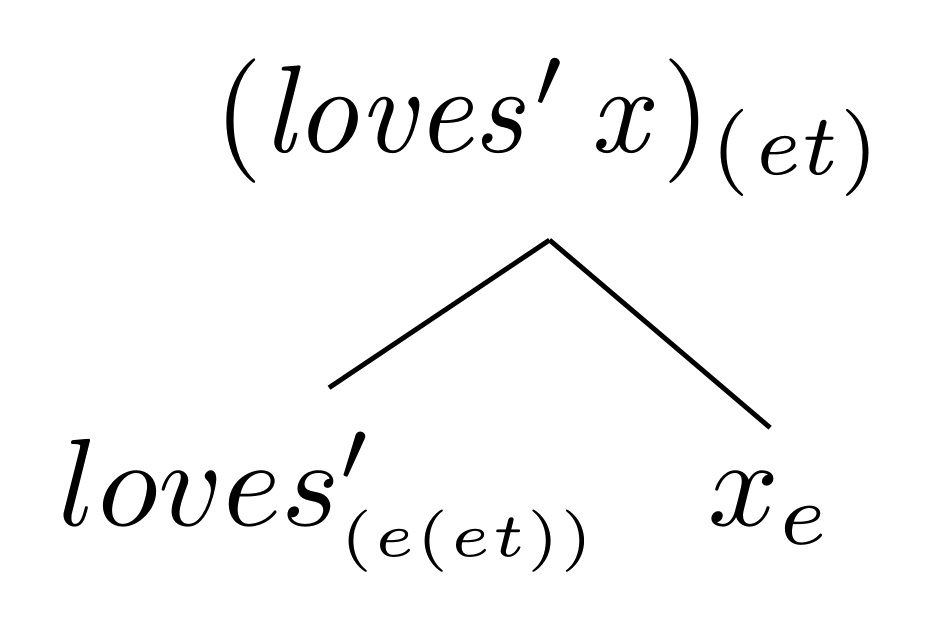
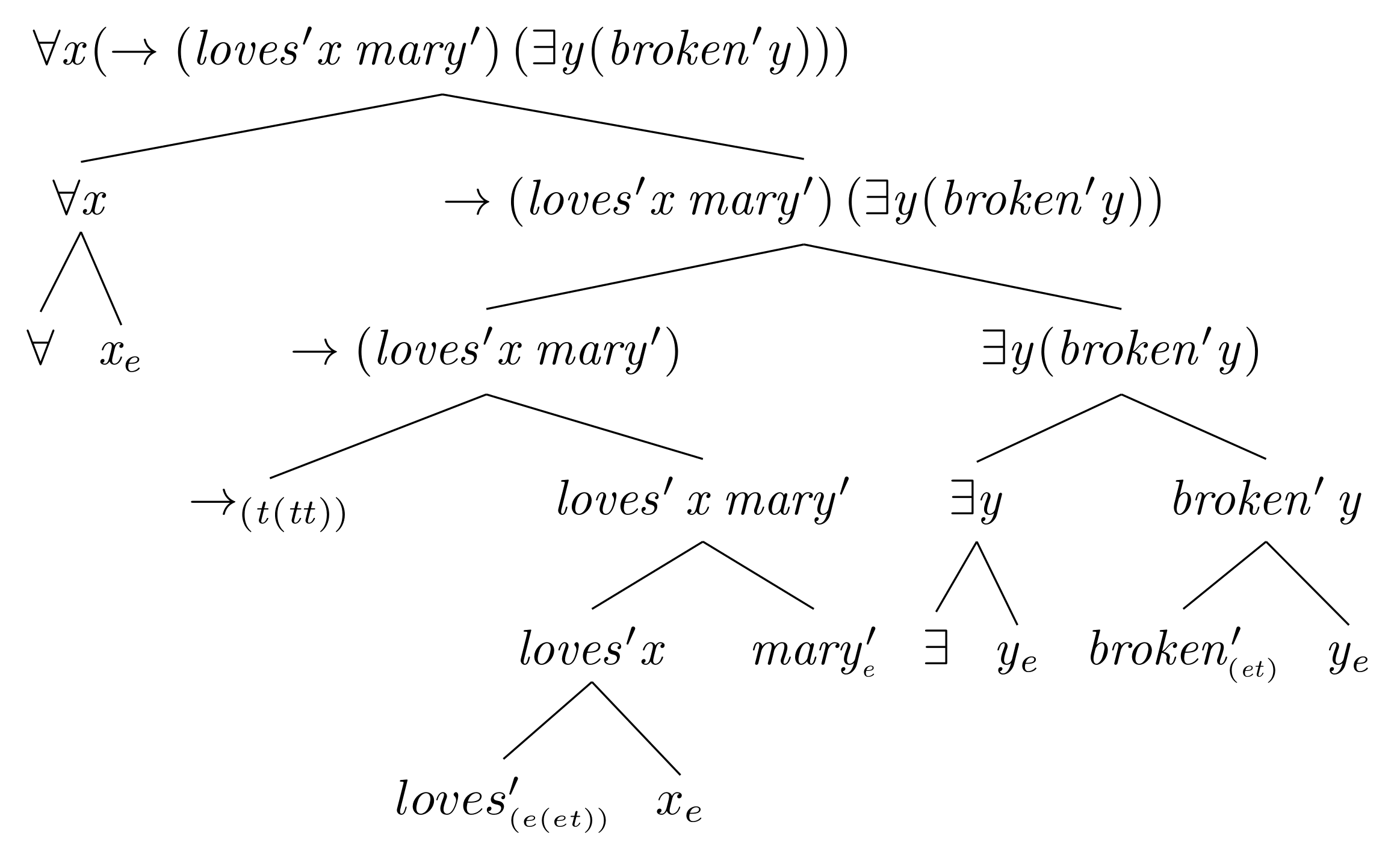
The leaves of the tree \(\tcon{loves}{(e(et))}\) and \(x_{e}\) are validated by Clause (1), while application of the former to the latter to form the root of the tree, , is validated by Clause (2). Now we take a further step and apply the function we obtained in to another item from our vocabulary, this time a constant rather than a variable:
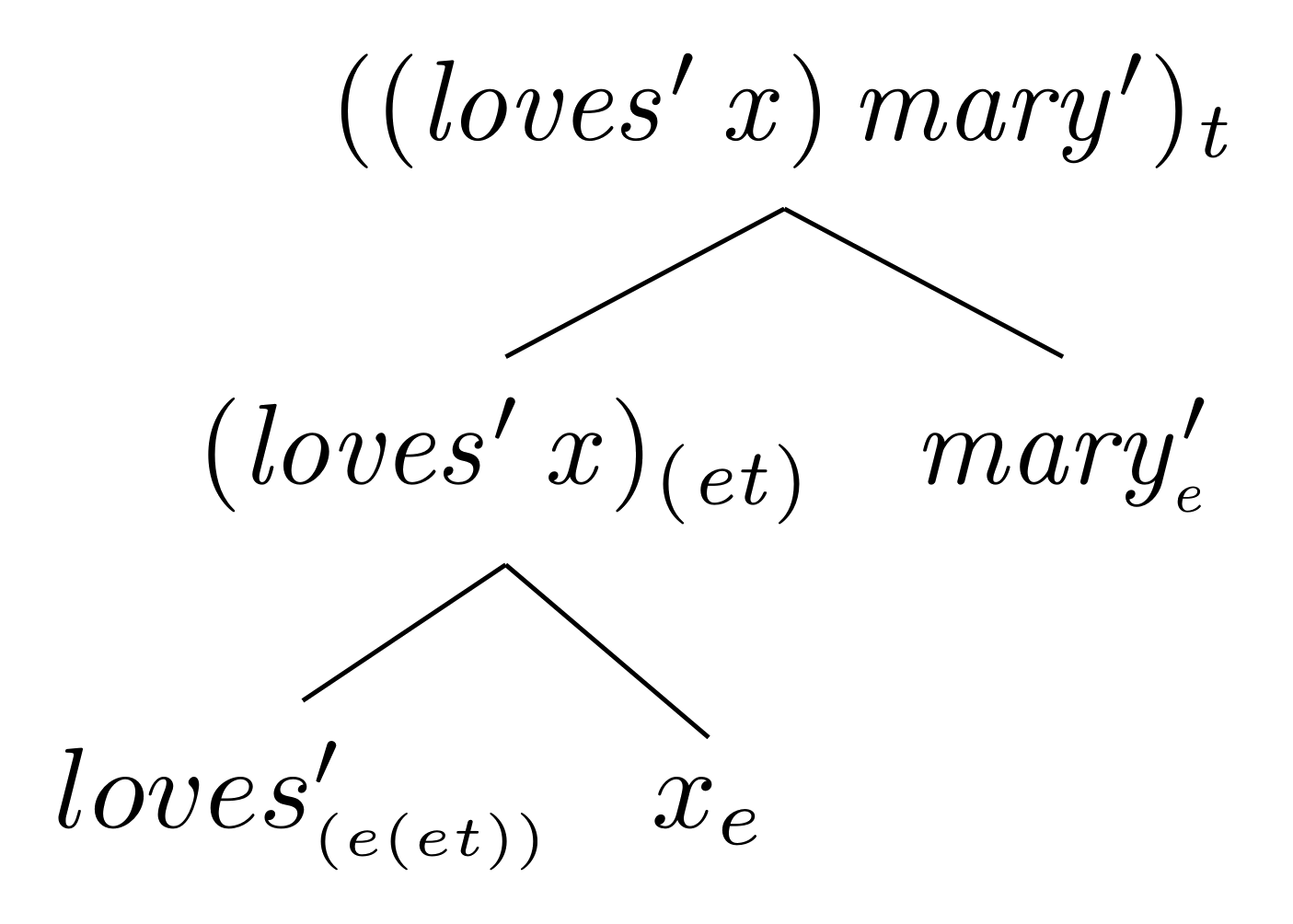
Our type system says that the expression at the root of is of type \(t\), which means it must stand for something that can be true or false. An approximation to this formal expression from natural language would be Mary loves it, him or her. The variable acts like a pronoun as mentioned above. And as in the case of natural language pronouns, we cannot decide on the truth value of the expression unless we know who or what the variable (or pronoun) stands for.
So far we made use of Clauses (1) and (2) of . Now let us see Clause (3) in action.
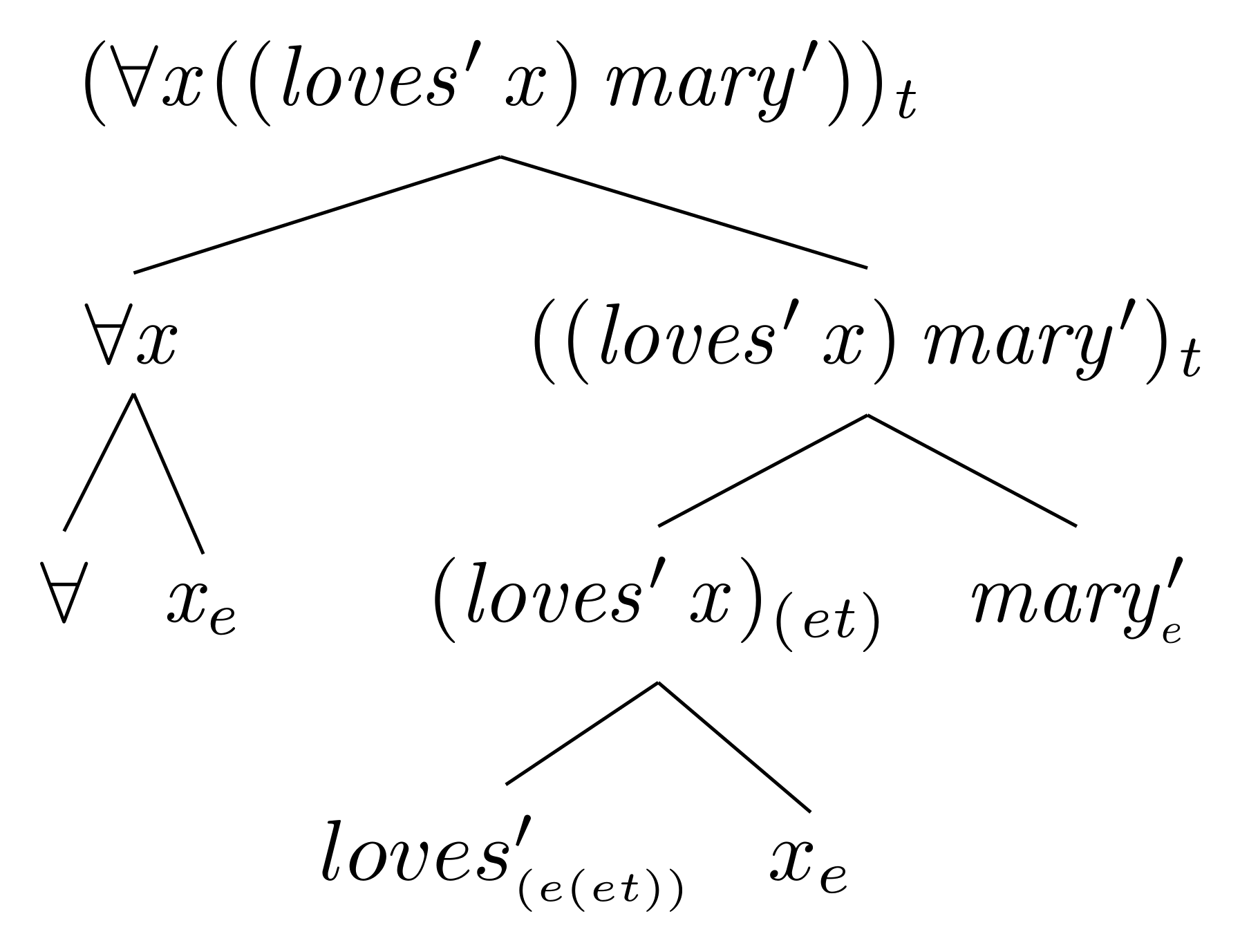
What we have here is an approximation to the sentence Mary loves everything.
In a similar fashion, we can invite our connectives into the business. Connectives will also be curried functions, so that they can be applied to their arguments one by one. For instance, the conditional will be applied to its antecedent and consequent one by one, resulting in the following equivalence to standard logical notation:
\[\begin{align*} ((\to \alpha)\beta) \equiv \alpha\to\beta \end{align*}\]Here is a representation corresponding to For any individual, if Mary loves him or her, then there is someone who gets broken:
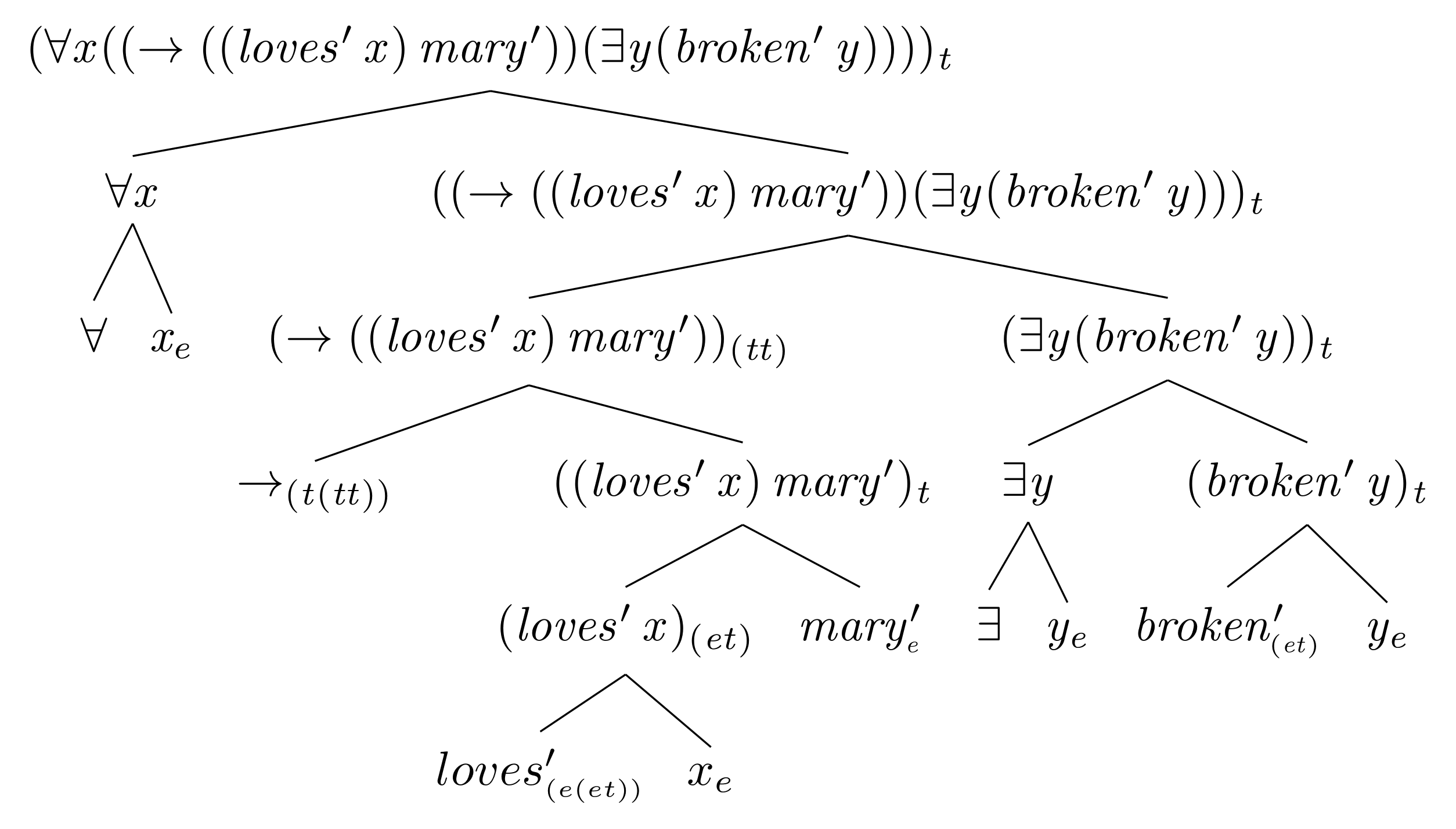
The formulas in their current forms are quite hard to read. One way to make them more readable is to agree on a convention to eliminate some parentheses. From now on we agree that in function application (i) outermost parentheses are omitted, and (ii) application associates to left. The first is easy to grasp: \(((fx)y)\) becomes \((fx)y\). The second needs some time get used to. Assume you are given an expression with some of its parenthesis are removed. Left association means that in restoring the parentheses back, you start from the two left most expressions, without looking into parentheses you encounter when counting the left-most two. Here are a couple of examples:
\[\begin{align*} x\cnct y \cnct z &\equiv& ((xy)z) & \\ x(yz) &\equiv& (x(yz)) &\\ x(yz)w &\equiv& ((x(yz))w) & \end{align*}\]Let us now apply these parentheses elimination conventions to ; observe that the type decorations goes away with the outer parentheses, you need to mentally keep track of them:
Semantics
Now it is time to give a semantics to our formal language \(L\). But before we embark on that task let’s preempt a nasty confusion of terminology. Below, we will use the term domain in a sense different from the usual one. The usual sense of the term is “the set of input values of a function”; but we will use it in a second sense, according to which the domain of a function \(f\) is the the set of all functions that has the same type as \(f\). In this extended sense, the domain of the function \(f(x)=x^2\) is the set of all functions from \(\mathbb{R}\) to \(\mathbb{R}\). The sense will also apply to non-functional objects.
First we define a model. A model \(\mathcal{M}\) is a tuple \(\langle D_e,D_t,I\rangle\), where \(D_e\) is the domain of individuals (i.e. a set of \(e\) type entities), \(D_t\) is the domain of truth values (usually ${0,1}$), and \(I\) is the interpretation function. We need some more notation to understand the mechanics of \(I\).
Given two sets \(X\) and \(Y\), \(X^Y\) denotes the set of all functions defined from \(Y\) to \(X\).
The notation is motivated by the fact that given two sets \(X\) and \(Y\) with cardinalities \(m\) and \(n\), respectively. There exists \(m^n\) functions from \(Y\) to \(X\).
Given a model \(\mathcal{M}=\langle D_e,D_t,I\rangle\), the domain of any type of objects can be denoted using . For instance, the domain of functions from entities to truth values is \(D_t^{D_e}\) or \(\{0,1\}^{D_e}\). For the domain of functions of type \((e(et))\) you will have \((\{0,1\}^{D_e})^{D_e}\), or for \(((et)t)\) you will have \(\{0,1\}^{(\{0,1\}^{D_e})}\), and in general the domain of functions of type \(\smtyp{\alpha}{\beta}\) is \(D_{\beta}^{D_{\alpha}}\).
For a model \(\mathcal{M} = \langle D_e, D_t, I \rangle\) to be a model for a language \(L\), the interpretation function $I$ should be able to return a value for all the constants (logical and non-logical) of \(L\) from the domain corresponding to the type of the constant. In other words, \(I\) needs to be an effective dictionary for the vocabulary of \(L\).
The interpretation function that comes with the model takes care of constants of our language; how about the variables? The variables – pronouns of \(L\) – are handled via the environment for evaluation, a function that maps variables of the language to corresponding objects in the model. Like the interpretation function \(I\), the environment, denoted by \(g\) maps each variable to an object with the same type. The fundamental difference between \(I\) and \(g\) is that the former is fixed by the model and does not change during the course of evaluation; the environment on the other hand is dynamic, it gets extended during evaluation. We define the extension of an environment as follows:
Given an environment \(g\), a variable \(x\), and a constant \(c\), an extension of \(g\) is the function denoted as \(\fnex{g}{x}{c}\) which is exactly like \(g\) possibly except that it maps \(x\) to \(c\).
It is time to state the semantics of \(L\) with respect to a model \(\mathcal{M}\) and an environment \(g\). You can think of evaluation as a higher order function denoted by double pipes: \(\interp{\psi}_{\mathcal{M},g}\) stands for the semantic evaluation of the expression \(\psi\) with respect to \(\mathcal{M}\) and \(g\).
- \(\interpp{\alpha} = g(\alpha)\), if \(\alpha \in V\)
- \(\interpp{\alpha} = I(\alpha)\), if \(\alpha \in C \cup K\)
- \( \interpp{(\alpha\beta)} = \interpp{\alpha}(\interpp{\beta}) \)
- \(\interpp{(\forall \alpha_{\pi} \beta)} = 1\) iff for all \(d \in D_{\pi}\), \(\interp{\beta}_{\mathcal{M},\fnex{g}{x}{d}} = 1\)
- \(\interpp{(\exists \alpha_{\pi} \beta)} = 1\) iff there is at least one \(d \in D_{\pi}\), \(\interp{\beta}_{\mathcal{M},\fnex{g}{x}{d}} = 1\)
Example
Let’s clarify over an example. Assume we were able to transform the sentence Whenever Mary loves someone, there is someone who will be jealous of the person Mary loves into the following logical form:
\[\begin{align*} \interpp{\forall x (\to (loves'\cnct x\cnct mary')\cnct (\exists y (jealous'\cnct x\cnct y)))} \end{align*}\]Any propositional expression like this can be either true or false with respect to a model. Therefore, we need to specify a model.
Here is our model \(\mathcal{M}\) and the environment \(g\):
\[\begin{align*} D_e = & \{\mtob{mary,pedro,rosinante}\} \\ D_t = & \{1,0\}\\ I = & \{(mary',\mtob{mary}), (pedro',\mtob{pedro}),\\ & (loves',\{(\mtob{mary},\{(\mtob{rosinante}, 1), (\mtob{pedro}, 1), (\mtob{mary}, 0)\}),\\ & \quad\quad\quad\quad (\mtob{pedro}, \{(\mtob{rosinante}, 0), (\mtob{pedro}, 1), (\mtob{mary}, 0)\}), \\ & \quad\quad\quad\quad (\mtob{rosinante}, \{(\mtob{rosinante}, 0), (\mtob{pedro}, 0), (\mtob{mary}, 1)\})\}), \\ & (jealous',\{(\mtob{mary},\{(\mtob{rosinante}, 0), (\mtob{pedro}, 1), (\mtob{mary}, 0)\}),\\ & \quad\quad\quad\quad (\mtob{pedro}, \{(\mtob{rosinante}, 1), (\mtob{pedro}, 0), (\mtob{mary}, 0)\}), \\ & \quad\quad\quad\quad (\mtob{rosinante}, \{(\mtob{rosinante}, 0), (\mtob{pedro}, 0), (\mtob{mary}, 1)\})\})\}\\ g = & \{(x,\mtob{rosinante}),(y,\mtob{rosinante})\} \end{align*}\]We do not provide the interpretations of logical constants, which are taken to be the standard logical connectives.
The first invoked clause of is (4):
\[\begin{align*} & \interpp{\forall x (\to (loves'\cnct x\cnct mary')\cnct (\exists y (jealous'\cnct x\cnct y)))} = 1 \text{ iff }, &\\ & \text{for all } d \in D_e,\quad \interp{(\to (loves'\cnct x\cnct mary')\cnct (\exists y (jealous'\cnct x\cnct y)))}_{\mathcal{M},\fnex{g}{x}{d}} = 1 \end{align*}\]We start iterating over \(D_e\), replacing \(x\) with a model-theoretic object in \(D_e\) and checking whether we obtain 1 as result. First,
\[\begin{align*} \interp{(\to (loves'\cnct x\cnct mary')\cnct (\exists y (jealous'\cnct x\cnct y)))}_{\mathcal{M},\fnex{g}{x}{\mtob{mary}}} \end{align*}\]This invokes clause (3):
\[\begin{align*} \interp{(\to (loves'\cnct x\cnct mary')}_{\mathcal{M},\fnex{g}{x}{\mtob{mary}}} (\interp{(\exists y (jealous'\cnct x\cnct y))}_{\mathcal{M},\fnex{g}{x}{\mtob{mary}}}) \end{align*}\]To handle this function argument form, let us first compute the function part \(\interp{(\to (loves'\cnct x\cnct mary')}_{\mathcal{M},\fnex{g}{x}{\mtob{mary}}}\), which is itself a function application, invoking clause (3) again:
\[\begin{align*} \interp{\to}_{\mathcal{M},\fnex{g}{x}{\mtob{mary}}} (\interp{(loves' x\cnct mary')}_{\mathcal{M},\fnex{g}{x}{\mtob{mary}}}) \end{align*}\]Now evaluate \(\interp{(loves' x\cnct mary')}_{\mathcal{M},\fnex{g}{x}{\mtob{mary}}}\), invoking clause (3):
\[\begin{align*} \label{lovesxmary} \interp{(loves' x)}_{\mathcal{M},\fnex{g}{x}{\mtob{mary}}} (\interp{mary'}_{\mathcal{M},\fnex{g}{x}{\mtob{mary}}}) \end{align*}\]Evaluate \(\interp{(loves' x)}_{\mathcal{M},\fnex{g}{x}{\mtob{mary}}}\), once again invoking clause (3):
\[\begin{align*} \label{lovesx} \interp{loves'}_{\mathcal{M},\fnex{g}{x}{\mtob{mary}}} (\interp{x}_{\mathcal{M},\fnex{g}{x}{\mtob{mary}}}) \end{align*}\]Evaluate \(\interp{x}_{\mathcal{M},\fnex{g}{x}{\mtob{mary}}}\), invoking clause (1):
\[\begin{align*} \interp{x}_{\mathcal{M},\fnex{g}{x}{\mtob{mary}}} = \fnex{g}{x}{\mtob{mary}}(x) = \mtob{mary} \end{align*}\]We also have the following by clause (2),
\[\begin{align*} \interp{loves'}_{\mathcal{M},\fnex{g}{x}{\mtob{mary}}} = I(loves') \end{align*}\]the evaluation step yields a function from \(e\) type objects to \(t\) type objects:
\[\begin{align*} I(loves') (\mtob{mary}) \\ = \{(\mtob{rosinante}, 1), (\mtob{pedro}, 1), (\mtob{mary}, 0)\} \end{align*}\]We have,
\[\begin{align*} \interp{mary'}_{\mathcal{M},\fnex{g}{x}{\mtob{mary}}} = I(mary') = \mtob{mary} \end{align*}\]Feeding this into its function, we get 0 as the value. Feeding 0 to the interpretation of \(\to\) would yield the function \(\{(0,1), (1,1)\}\). The next task is to compute the value for the consequent of the conditional with the extended environment and completing the iteration for \(x\mapsto \mtob{mary}\). The iteration has to go on until we are out of objects in \(D_e\). The completion of the evaluation is left as an exercise.
This was a brief and dense introduction to model-theoretic interpretation. It aimed to introduce how to define a semantics for a formal language that can be used as a logical form for natural language expressions. The research in natural language morphosyntax-semantics correspondence concentrates on how to map natural language expressions to logical forms. In such a setting logical forms serve an intermediary ground between form and meaning, just like intermediary languages and representations used in translating high-level programming languages to machine executable code. There are, broadly speaking, two camps that differ in the role they confer to intermediary representations. For one camp, the logical form is theoretically superfluous. According to this camp, semantic theory is a direct mapping from forms to model-theoretic objects, and logical form is there only to make this mapping more readable, or less complex to track, contributing nothing to the explanatory power of the theory. The other camp, on the other hand, takes logical form to be an essential part of the theory, where certain principles and mechanisms are defined at the level of logical form. In either case, the interpretation of logical forms has to be understood and internalized by semanticists, although it will not be part of their regular research practice. This paragraph will be justified.