Solution: Two envelopes
A tough problem. Let’s call the unknown amounts \(a_1\) and \(a_2\) with \(a_1 < a_2\).
Here is the description of the process:
- You pick one of the two envelopes at random, with the probability of a succesful choice \(P(S) = \frac{1}{2}\).
- Next you run a coin experiment with three possible outcomes:
- \(X > d_2\), a max \(X\), call this event \(A\).
- \(d_1 < X < d_2\), a mid \(X\), (event \(B\)).
- \(X < d_1\), a min \(X\), (event \(C\)).
- Finally, you either switch or not, depending on your comparison of \(X\) with the amount in your envelope.
We do not know any of \(P(A)\), \(P(B)\), \(P(C)\), but we do know that they sum to 1.
The solution is to be sought by constructing a probability tree with \(2\times 3 \times 2\) leaves, each corresponding to an outcome of the entire process.
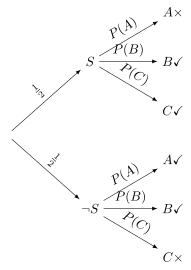
THen, the probability of winning with this strategy must be equal to the sum of the success branches in the above tree, which is:
\[\begin{align*} P(W) & = \frac{1}{2}\cdot (P(A) + 2\cdot P(B) + P(C))\\ & = \frac{1}{2}\cdot (P(A) + P(B) + P(C)) + \frac{1}{2}\cdot P(B)\\ &= \frac{1}{2} + \frac{1}{2}\cdot P(B) \end{align*}\]As \(X\) takes values in \([1.5,\infty)\) and \(d_1>1\) (by problem definition), \(P(B) > 0\); therefore \(P(W) > \frac{1}{2}\), with the suggested strategy.